Guides How to sow white clover seed in pasture

Are you making the most of white clover? This perennial forage legume can lift your livestock production while unlocking environmental benefits. Use our guide to maximise the sustainable production potential of white clover in your grassland system.
Contents
1. White clover benefits: What does it bring to grassland?
- Improves grazing quality
- High in protein and key minerals.
- Drives dry matter (DM) intake in summer and autumn.
- Increases milk production and liveweight gain.
- Fixes atmospheric nitrogen and shares it for plant growth.
- Reduced reliance on nitrogen fertiliser.
- Enhances soil structure and fertility.
- Supports pollinators
2. How does white clover grow?
Stolons are multi-branched creeping stems and are key to the survival and production of white clover. These stems provide sites for new leaves, roots, and flowers. A store for carbohydrates and proteins, stolons also enable white clover to overwinter and regenerate in spring.
White clover varieties (Trifolium repens) vary in leaf and stolon characteristics. The differences in leaf size can be significant and determine agronomic performance, as explained later.
Clover root systems improve soil structure and ease soil compaction. Studies at the Institute of Biological, Environmental and Rural Sciences (IBERS) found improved soil structure from higher white clover content in swards:
- White clover has been proven to significantly decrease soil density and increase porosity.
- Fertiliser recovery rose from less than 50% to over 75% in soils with improved structure due to white clover.
- General movement of nutrients was also improved and produced more grass.
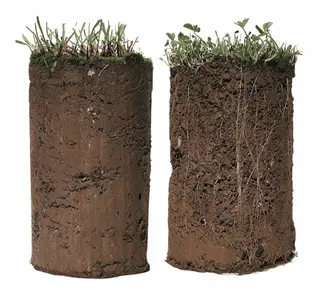
Image: Left root column with grass only; right root column with grass and clover.
3. Nitrogen fixation in clover
Nitrogen fixation is a biological process in which atmospheric N2 is converted into forms that can be used by clover plants. Rhizobia bacteria colonise the root nodules of clover, then take nitrogen as ammonium from the air and convert it into a plant-available form. The nitrogen becomes available for companion grasses as it’s released following plant decay.
Swards with an average white clover content of 25-30% across the year can fix around 150kg N/ha annually from the atmosphere, sharing surplus N with surrounding plants. The exact amount fixed depends on:
- White clover content of swards: More nitrogen is fixed as clover content increases.
- Nitrogen fertiliser application rate: Less nitrogen is fixed if more artificial nitrogen is applied.
- Soil temperature: The rate of nitrogen fixation increases as the soil temperature rises, with 8°C and above needed for fixation to start. The optimum fixation is then reached above 15°C, with fixation declining at temperatures above 25°C.
4. White clover growth stages
Rosette Phase
- Approximately 0-3 months post-sowing.
- Reliant on the central taproot.
- Few stolons
- Small spread
- No nitrogen fixation
- Important to graze to promote growth.
Expansion phase
- 3-6 months post-sowing.
- Still reliant on the central taproot.
- Rapid expansion of up to 15 stolons, around 25-30cm in length.
- Initial rooting of the stolons is poor, so graze carefully to avoid damage.
Clonal phase
- Reliant on adventitious roots forming on the stolon nodes.
- Stolons last for 12-18 months with the cycle repeating each year.
- New stolons are produced at the terminal bud and grow independent plants.
- Good grazing management helps maintain stolon production and persistence in grazing leys.
- Active nitrogen fixation occurs.
5. White clover leaf size: Why it matters
Small leaf
- More persistent
- Lower yielding
- Tolerant of tight grazing (e.g. sheep grazing).
Medium leaf
- Intermediate for yield and persistency.
- Suitable for dairy and beef grazing.
Large leaf
- Higher yielding
- Aggressive and can dominate leys.
- Suitable for silage leys.
6. Livestock performance
White clover is a forage crop that’s high in quality and digestibility, driving improved livestock feed intakes and performance. Below, we explore a few standout trials supporting this.
Metabolisable energy (ME) and crude protein (CP): Early, mid, and late season
Using Germinal Horizon research, this table shows how clover provides high protein levels that build across the season. It also offers valuable ME when grass growth slows in summer.
| Species | Early season | Mid-season | Late season | |||
| ME (MJ/kg) | CP (%) | ME (MJ/kg) | CP (%) | ME (MJ/kg) | CP (%) | |
| Perennial ryegrass | 11.43 | 13.99 | 10.79 | 12.13 | 11.22 | 16.34 |
| White clover monoculture | 11.65 | 25.17 | 11.01 | 20.51 | 11.77 | 23.52 |
Source: Germinal Horizon, 2023
Feed value: Perennial ryegrass vs clover
And when combining perennial ryegrass with white clover, you can see below how a mixed sward can outperform a monoculture for total dry matter (DM). In a four-year research trial at Germinal Horizon Wiltshire, the average annual yield was 24.29% higher for perennial ryegrass and white clover.

Source: Germinal Horizon, 2020-23
Milk production
For dairy systems, grass-clover swards have the potential to lift performance. This is backed by a Teagasc grazing experiment at its Moorepark site. Higher performance for milk yields, fat content, protein content, and milk solids was recorded for perennial ryegrass and white clover at 150kg N/ha and 100kg N/ha versus perennial ryegrass only at 200kg N/ha.
| Grass only (200kg N/ha) | Grass-clover 19.8% (150kg N/ha) | Grass-clover 20.1% (100kg N/ha) | |
| Milk yield (kg/cow) | 5,650 | 5,881 | 5,878 |
| Fat content | 5.16% | 5.30% | 5.36% |
| Protein content | 3.70% | 3.73% | 3.76% |
| Milk solids yield (kg/cow) | 504 | 534 | 537 |
Source: Teagasc, 2023-24
Meat production
A study at Teagasc Grange (2023/24) shows the production potential for beef systems. After grazing only grass, heifers and steers were fed grass silage and 1.5kg of concentrate per day when housed.
Meanwhile, the grass-clover groups grazed grass and white clover, followed by red clover silage when housed. For both heifers and steers, the grass-clover groups generated higher carcass value.
| Heifers | Steers | Mean difference: Grass vs grass-clover | |||
| Carcass traits | Grass-only | Grass-clover | Grass-only | Grass-clover | |
| Final live weight | 571 | 592 | 598 | 630 | 27kg |
| Carcass weight | 299 | 308 | 313 | 340 | 18kg |
| Fat score (1-15) | 3= | 3= | 2+ | 3- | Similar |
| Carcass value at €5/kg | 1,605 | 1,669 | 1,647 | 1,809 | €113 |
Source: Teagasc, 2023/24
7. How to sow white clover
Seedbed: Soil fertility
A clean seedbed is essential and should ideally be ring-rolled before sowing. Your optimum soil pH is 6.0-6.5. Liming to correct pH should be carried out well ahead of sowing.
Fertiliser nitrogen should only be applied in low N status soils, up to 50kg N/ha. Phosphate (P2O5) and potash (K2O) are required at application rates of 50-120kg/ha, depending on your soil indices.
When to sow: Spring or autumn
April to mid-August is the optimum sowing period for white clover on most UK farms. Ultimately, your soil temperature should be above 8°C to help white clover establish. Seedlings must have begun producing stolons before the onset of winter.
Reseeding: Seed rate and sowing depth
You can sow white clover seed with perennial ryegrass by drilling in a full reseed. However, broadcasting is generally the most reliable method of establishment.
Mixtures should contain 2-4kg/ha (0.75-1.5kg/acre), depending on environmental conditions, to achieve target establishment and an optimum balance in swards.
The optimum sowing depth for white clover seed is 5-10mm. Don’t sow any deeper as the seeds are small and need their full energy reserves to surface.
Find our full grassland reseeding guide here.
Overseeding white clover: How’s it done?
White clover can be overseeded in existing swards by different methods, from slot seeding to broadcasting following scarification.
- Before sowing, minimise competition from existing plants by heavy grazing and/or harrowing to open up leys.
- Observe normal sowing timings (April to August) and soil nutrient/pH status parameters.
- If there is enough soil moisture (e.g. after a silage cut), take advantage when grass growth is least vigorous (after flowering in July).
- Ensure soil is sufficiently disturbed to allow seed contact and coverage (5-10 mm seed depth).
- Use a higher seed rate (4 kg/ha or 1.6 kg/acre) than conventional sowing to compensate for greater seedling loss. Lower seed rates (from 2.4kg/ha or 1kg/acre) are suitable for periodic top-ups in long-term swards.
- Watch out for slugs and use pellets to control if needed.
- Graze lightly and in short periods until white clover is well established.
8. Grazing white clover: Timing matters
Spring
- Target early spring grazing to kickstart clover growth.
- Avoid poaching or damaging leys.
- Be flexible by using on-off grazing and target wetter paddocks in drier weather.
- Aim for a 3.5cm post-grazing sward height.
Mid-season (April to July)
- Maintain a pre-grazing cover of 1,300-1,600kg DM/ha and a pre-grazing height of 8-10cm.
- Target post-grazing ley height of 4cm.
- Reduce N fertiliser on leys with >25% clover.
Autumn
- Extend your rotation length to build grass cover from early to mid-August.
- Close your farm in rotation from early October.
- Target post-grazing ley height of 3.5-4.0cm on the final rotation.
- Avoid poaching or damaging leys.
- Be flexible by using on-off grazing.
- Reduce N fertiliser on leys with >25% clover in August.
- Close paddocks with a high clover content towards the end of your final rotation.
Bloat risk
Bloat is the excessive build-up of gas (carbon dioxide and methane) in the rumen, resulting in distress and possible death due to the exertion of pressure on the animal’s diaphragm, heart and lungs.
Some legumes, including white clover, present an increased bloat threat in cattle. This is caused by the rapid breakdown of protein in the rumen. However, you can minimise the risks of bloat by adopting these best practices:
- Limiting access to clover swards when stock are first introduced. For example, by using a breakfast break that forces the animals to graze grass with fibre.
- Avoiding turnout of hungry stock onto high clover fields
- Feeding high dry matter forage such as hay/straw before turnout.
- Offering hay/straw at intervals (for example, to dairy cows at milking times).
- Administering an anti-bloat treatment to livestock (for example, bloat oil in the water).
- In high-risk periods, check livestock often following turnout. Treat animals immediately where necessary.
9. How to manage white clover swards
Grass-clover balance
Maintaining an optimum dry matter balance of 30% white clover to 70% perennial grass as an average across the season is the key to grass-clover management. This will maximise clover’s nutritional and nitrogen-fixing attributes alongside high-yielding grass.
Dominance
The balance of white clover to grass is often visually overestimated. However, if it does become dominant and very little grass is visible, it can outcompete and unbalance your swards. This can happen in the second year, with a better balance seen from the third year.
Consider these actions if clover dominance is a major issue:
- Avoid using large leaf clovers in grazing swards.
- Tactical application of nitrogen to enhance grass growth.
Pests to watch for
- Slugs: Potentially devastating in problem areas, particularly in drilled crops.
- Stem eelworm: Causes distortion of growing buds and young leaves and death of the plant.
- Sitona weevil: More common close to arable areas and leads to the removal of small semi-circular sections of leaflets.
- Leatherjackets: Can emerge after ploughing older pastures.
Diseases
The most common disease affecting white clover is clover rot (Sclerotinia). This causes a generalised rot of the plant. Germinal white clover varieties are bred with stem nematode resistance.
Weeds
A clean seedbed is essential to avoid competition from weed species during establishment. Most annual and some perennial weeds can be controlled by regular pasture topping. Where available, a clover-safe spray can be used if plants are vigorous and well developed.
Find more advice on grassland weed control here.
The natural nitrogen maker
Want to do more with red clover? You can find it in multiple mixtures across our Climate Smart ranges. Offering performance plus sustainability, these mixtures have been expertly formulated to give you the best of both, with no compromise on production.
Share article