Research Plotting performance: Germinal Horizon shares four key multi-species research findings
18 February 2026
In 2025, Germinal Horizon was recognised for its extensive research into how multi-species swards can support sustainable grassland farming, featuring as a subject matter expert in the European Grassland Federation’s (EGF) 23rd Symposium.
Visiting Germinal Horizon Wiltshire, delegates explored trial plots showcasing the past, present, and future varietal successes of the grass and forage breeding work from the Institute of Biological, Environmental, and Rural Sciences (IBERS) and later Germinal Horizon.
The plots highlighted the importance of including sustainably productive varieties in multi-species mixtures. You can learn more about these varieties by reading part one of our EGF recap.
In part two, we invite you to review the key findings of a four-year multi-species trial conducted at Germinal Horizon Wiltshire and which was shared with the EGF delegates.
1. The high-yielding potential of multi-species
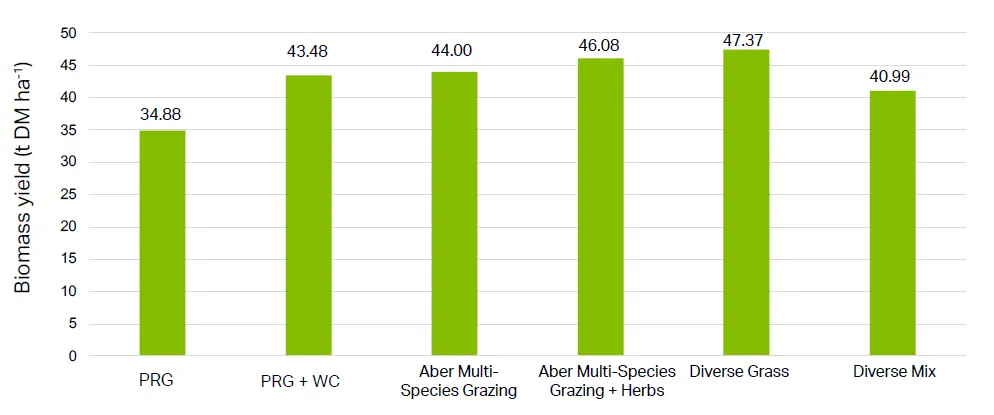
Yield is vital for grassland farmers, so the trial analysed the biomass yield of swards sown with six different mixtures from 2020 to 2023. These included perennial ryegrass only, perennial ryegrass plus white clover, and four different multi-species combinations. You can find a full breakdown of the exact seed mixture formulations here, including key research charts.
Mean lifetime yield: 2020-23
Source: Germinal Horizon Wiltshire
The perennial ryegrass monoculture (PRG) mixture was the lowest-yielding – 14.8% less than the Diverse Mix, as the next lowest. Comparing the monoculture with the Aber Multi-Species Grazing mix, there was a 26.1% yield increase. That’s a significant improvement for grassland farmers who establish multi-species swards to replace grass-only pasture.
In the early trial years, the mixes with higher herbal content generated the largest yields before decreasing later, whereas the perennial ryegrass and white clover sward performed consistently well across the entire period.
While the data supported sward diversity, it also cautioned against using too many different species – the Diverse Mix contained 16 species, the most of any mixture. However, with the Diverse Mix having the lowest seed rate of perennial ryegrass, this limited the first cut production levels. Although this increased the persistency of smaller herbs, less biomass yield was produced.
2. Sustainable production in dry periods
Germinal Horizon understands that there’s more to forage production than annual yields. Facing unpredictable weather patterns from climate change, grassland farmers across the UK, Ireland, and Europe now encounter prolonged droughts.
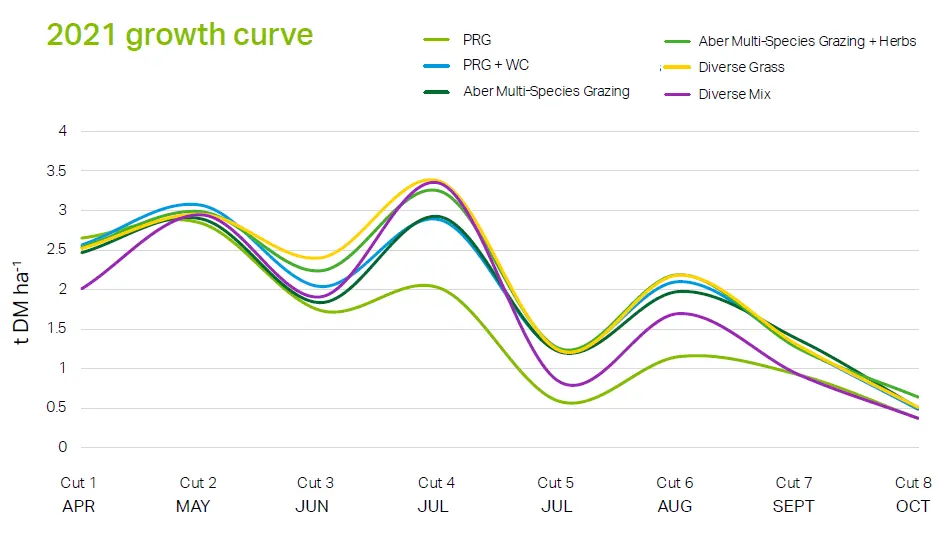
For Germinal Horizon Wiltshire, it was crucial to understand how multi-species swards grow across an entire season. Below, you can see how the six trial mixtures performed in 2021, measured by tonnes of dry matter per hectare.
Seasonal mixture growth
Source: Germinal Horizon Wiltshire
The PRG monoculture sward started strongly before diverging from the trend at cut three. Where the multi-species swards generated their highest yields at cut four in July, the monoculture produced around 50% less yield than the best-performing mixtures. And this divergence continued for the rest of summer 2021, through cuts five and six. In fact, the gap didn’t significantly close until cut eight in October.
This research shows that combining perennial ryegrass with multi-species provides a sustainable forage source across an entire season. Monocultures or mixtures that favour too many species are at risk of leaving farmers with forage gaps.
3. How swards change over time
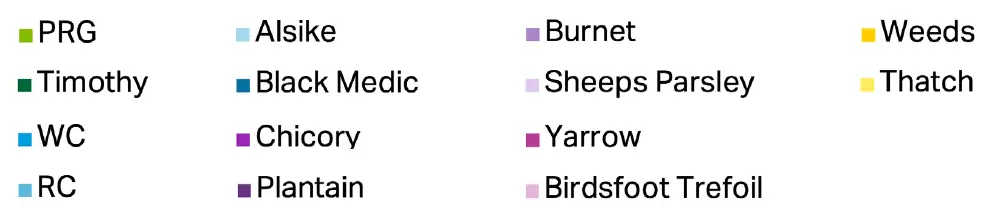
Below are pie charts showing the evolution of the Aber Multi-Species Grazing + Herbs sward from 2020 to 2023. It’s worth focusing on because it evaluates a more diverse variant of our core multi-species mixture but without including the less productive herbs found in the Diverse Mix.
Mixture composition: 2020-2023

Source: Germinal Horizon Wiltshire
In 2020, we can see chicory and plantain dominating the sward from the outset. After the first cut in 2021, both species fell to much lower levels in 2022 and 2023. In fact, only chicory maintains a noticeable percentage in 2023’s fourth cut.
In 2021 and 2022, the clovers established a stronger presence, especially later in the season after a slower start in spring. This is typical of clover needing a higher spring soil temperature than perennial ryegrass to start growth. By 2023, perennial ryegrass controls well over 50% of the sward, with weeds starting to creep in.
While multi-species can be a powerful forage option, grassland farmers need to monitor performance and be prepared to reseed when swards become unproductive and quality diminishes.
4. Applied nitrogen: Less is more for legumes
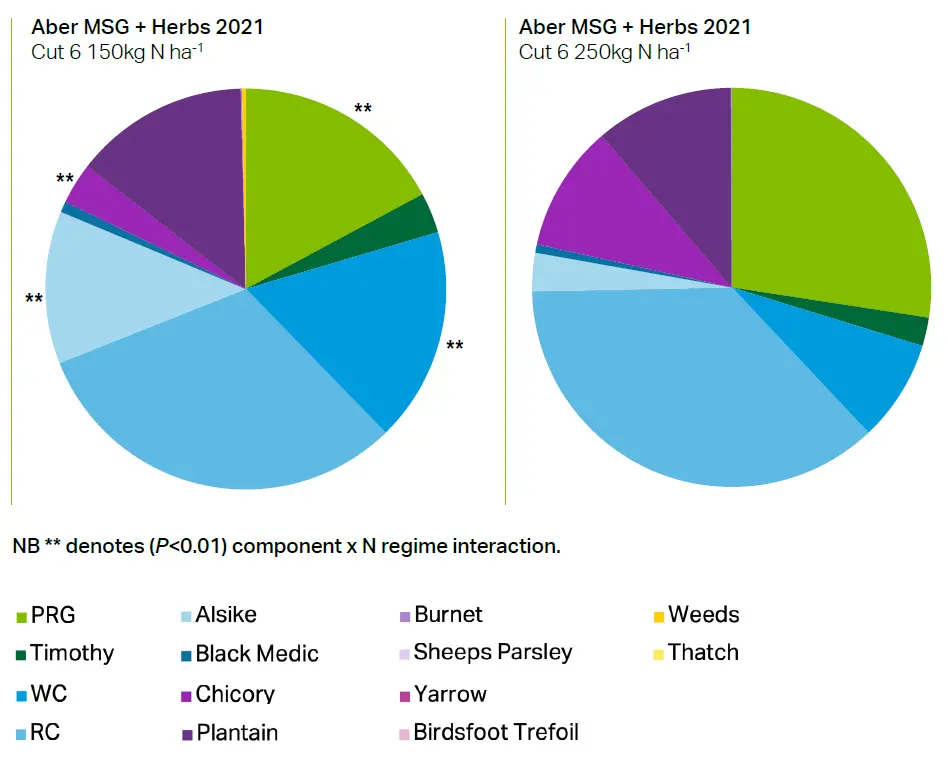
While many grassland farmers now closely control their nitrogen fertiliser use, this is often still needed to effectively manage new swards. Below, you can see the difference between applying 150kg nitrogen (N) per hectare (ha) and 250 kg N/ha on the Aber Multi-Species Grazing + Herbs sward.
While there are initially no differences in the sward, as time progresses, N applications apply a selection pressure and the productive elements of the sward changes in reaction to this.
Nitrogen regime impact on sward composition
Source: Germinal Horizon Wiltshire
Farmers apply nitrogen fertiliser to increase biomass yields, but this can decrease the presence of legumes. Above, the chart shows that increasing fertiliser applications from 150kg N ha-1 to 250kg lowered the compositional shares of white and alsike clovers. This shows that legume contribution to yield is higher at 150kg N ha-1.
As for the benefits of the 250kg N ha-1 regime, this did significantly increase the production of perennial ryegrass, red clover, and chicory.
Germinal Horizon’s key multi-species findings
- Multi-species produce higher yields than monoculture perennial ryegrass swards.
- They deliver more consistent yield across an entire season.
- Their sward composition evolves across months and years.
- Yield contribution from legumes can be higher with less applied nitrogen.
What’s next?
For future research, Germinal Horizon has formulated several threads for further investigation:
- How do residual cutting heights impact sward composition, yield, and quality?
- Are there differences in the persistency of multi-species sward components under different defoliation intervals?
- Is the increased yield from longer defoliation intervals utilisable?
- Is there an impact on soil health from livestock treading in more lignified plant growth?
- How does selective grazing impact the quality of forage when adjusted for sward intake?
Subscribe for more
For future updates on those topics and all other forage research, join the Germinal Horizon mailing list below.
"*" indicates required fields
Tags