News Forage crops for cattle: More than just feed
20 February 2026
What if you could cut feed costs, improve cattle performance, and operate more sustainably?
Growing the most effective forage crops for beef cattle can provide a cost-effective, high-quality feed solution that increases production and protects your bottom line.
Here’s how developing an efficient homegrown forage strategy can make your farm more profitable and resilient.
Benefits for herd
- Consistent nutrition: A diverse multi‑species mixture with high‑quality forage crops provides consistent nutrition, naturally rich in dry matter, protein, fibre, vitamins and minerals to sustain performance even during feed shortages.
- Improved rumen health: Fibre-rich crops such as hay or straw to support digestion and livestock well-being.
- Reduced feed costs: Homegrown forage crops can significantly reduce your reliance on costly bought-in feed, improving margins and giving greater control over quality and availability.
- Protein use efficiency: Germinal’s Climate Smart mixtures are formulated with Aber High Sugar Grass to help beef cattle capture more protein from grass. When used at scale, they may help increase daily liveweight gain by up to 20% while decreasing ammonia and nitrous oxide emissions.
- Summer resilience: During dry summers, grass growth can stall. Multi-species swards are better able to access moisture and maintain growth, providing valuable grazing when grass struggles.
- Winter feed security: Brassicas can help bridge forage gaps when grass growth slows or stops, allowing cattle to remain productive without excessive housing or concentrate use.
Benefits for the land
- Improved soil structure: Deep rooting species such as chicory and plantain help alleviate soil compaction, improving aeration and drainage.
- Enhanced soil fertility: Legumes fix atmospheric nitrogen, reducing the need for chemical fertiliser and boosting long-term soil fertility.
- Better nutrient cycling: Diverse root systems capture and retain nutrients more efficiently, reducing leaching and improving nutrient-use efficiency.
Performance: What the research shows
Higher forage output
Maximising forage yield is a priority to improve feed security and reduce input costs. A four-year study at Germinal Horizon Wiltshire shows the value of more diverse swards:
- Over 26% more dry matter per year from multi-species mixes with six and 10 elements versus ryegrass-only swards.
- There was even a 25% yield increase when simply diversifying with white clover.
2020-23: Average yield of different swards
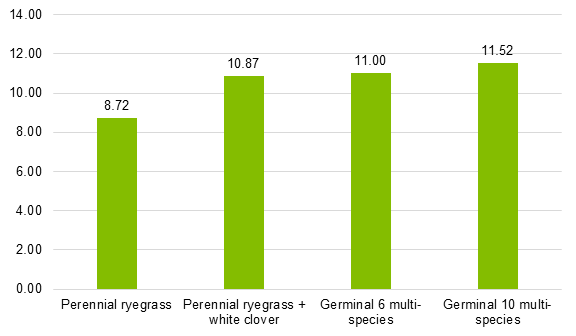
Source: Germinal Horizon Wiltshire
This supports more homegrown forage, stronger feed security and reduced reliance on purchased feed and nitrogen applications.
Improved growth and finishing performance
Multi-species swards
Research comparing different grazing swards (Beaucarne et al, 2025) shows that heifers grazing multi-species swards:
- Finished several days earlier.
- Reached higher slaughter weights than those on ryegrass or permanent pasture.
- Required significantly less nitrogen fertiliser to achieve these gains.
To explore these performance results in-depth, see our multi-species swards guide.
Red clover silage
Trials from Teagasc show red clover silage supports strong winter growth because cattle consume more of it:
- Higher dry matter intake than grass silage, leading to better daily liveweight gain (LWG).
- Cattle achieved around 1.04kg/day LWG on red clover silage versus 0.59kg/day on grass silage.
- Even when grass silage had higher digestibility, red clover still matched or outperformed it for LWG due to increased intakes.
Real results: Dylan Jones’ farm
At Castlellior Farm, Anglesey, beef finisher Dylan Jones uses red clover as the cornerstone of his feeding system.
By integrating red clover silage and homegrown barley, Dylan has doubled throughput, reduced fertiliser inputs, and maintained daily liveweight gains of 1.1-1.2 kg. His herd is finished efficiently, with minimal reliance on purchased protein.
Red clover provides both high-quality protein and nitrogen fixation, making the system profitable and sustainable.
Choosing the right forage crops for cattle
The most suitable forage depends on your soil type, grazing strategy and production goals.
If you’re looking for crops that deliver energy-dense feed, support growth targets and can withstand changeable weather conditions, these options will help finish cattle cost-effectively and reduce housing pressure.
| Forage crops | Features | Sowing | Utilisation |
| Red clover silage | High-protein, high-yielding silage crop. Excellent animal intakes and strong winter performance. Fixes nitrogen, reducing fertiliser need. | April-May | Cut for silage 2-3 times/year. Ideal for finishing or growing cattle over winter. |
| Multi-species swards | Diverse forage mix improves resilience, soil structure and dry matter production. Deep roots support forage growth in dry spells and boost mineral availability. | Late April-May | Grazing or cutting. Suitable for rotational grazing, finishing systems and building summer feed supply. |
| Stubble turnips | Quick to establish. Provides high-energy grazing for growing or finishing cattle. | April-August | September-February |
| Forage rape | Fast to establish and consistent feed value. Suits finishing cattle on deferred grazing systems. | May-August | October-December |
| Kale | Ideal for outwintering cattle. High-yielding. Resilient. | April-June | October-March |
| Hybrid brassicas | Provide extended grazing into late winter. | May-August | October-December |
Getting the most from cattle forage crops
To optimise forage utilisation and maximise cattle performance, allocation and grazing management are key:
- Plan grazing: Match the crop growth to livestock demand and move electric fences frequently. Long, narrow stripes work best.
- Stagger access: Don’t let all animals on at once. First calvers or lighter cows may need tailored feeding.
- Supplement fibre: Offer good-quality silage alongside high-energy crops.
- Monitor intake: Remove any animals not eating the crop and provide alternative feed.
- Transition slowly: Move cattle off forage crops 3-4 weeks before calving to allow rumen adaptation.
- Protect the sward: Avoid grazing wet fields and rotate strips to reduce poaching.
With the right forage system, you can unlock more from your feed, building resilience and profitability for your farm.
Ask the forage experts
If you need advice on which forage crops are best suited to your livestock farming system, feel free to ask our experts.
Tags